
Industrial Automation
Delivering an Automated Advantage for Our Customers
Industrial manufacturers are increasingly looking for flexible automation that can be deployed quickly, adapted easily, and operated safely alongside people. Brooks’ industrial automation solutions address these needs by helping manufacturers automate repetitive tasks, reduce variability, and improve productivity in dynamic production environments.
As part of Brooks’ emerging businesses, industrial automation extends our automation expertise beyond semiconductor manufacturing into broader industrial applications.

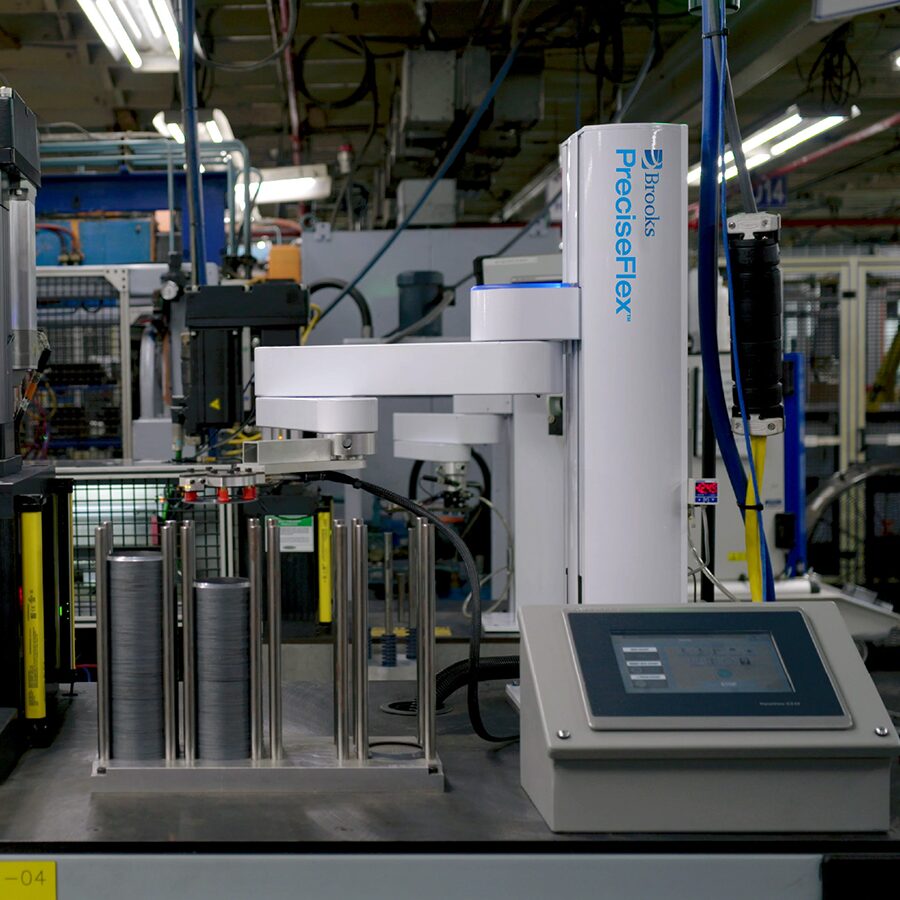
Industrial Automation Built for Flexible Manufacturing
Industrial manufacturing environments are evolving toward greater variability, shorter production runs, and more frequent process changes. These conditions require automation that can be introduced incrementally, adjusted as needs change, and integrated into existing operations without disrupting production.
Brooks industrial automation solutions are designed with this flexibility in mind. By supporting adaptable workflows and safe operation alongside people, Brooks helps manufacturers apply automation where it makes sense today while maintaining the ability to evolve and grow as production requirements change.
PreciseFlex™ Robots
PreciseFlex robots are designed to automate repetitive handling tasks where automation must operate safely alongside people. These robots support manufacturers looking to improve consistency and throughput without introducing rigid automation architectures that are difficult to change.
PreciseFlex robots are commonly used for applications such as electronics test & handling, machine tending, part transfer and pick-and-place. Their flexible design allows manufacturers to deploy automation incrementally, adapt workflows over time, and apply automation where it delivers the most value within existing operations.

Applications Across Industrial Manufacturing
Brooks’ industrial automation solutions are applied across manufacturing where flexibility, repeatability, and safe operation are required. These solutions support manufacturers seeking to automate targeted tasks within dynamic production workflows across industries such as electronics, automotive, medical devices, consumer products and warehousing.
Test and Electronics Handling
Automating the movement of parts through test and inspection processes to improve consistency while maintaining adaptable production layouts.
Pick-and-Place Operations
Handling small parts and components within dynamic workflows where repeatability, flexibility, and safe operation are required without relying on fully fixed automation.
Part Transfer and Handling
Moving parts reliably between process steps to support smooth material flow and reduce manual handling in evolving production environments.
Machine Tending
Supporting consistent loading and unloading of production equipment to maintain steady throughput, reduce variability, and support reliable operation across shifts and changing production schedules.
Tray, Tote, and Fixture Handling
Managing trays, totes, and fixtures within mixed-production environments where automation must adapt to changing formats and workflows.
Support and Collaborative Work Cells
Supporting automation in shared workspaces where people and robots operate together to improve efficiency while maintaining safety and flexibility.
Solving High-Value Problems

Managing Production Variability and Shorter Runs
Manufacturers increasingly operate with shorter production runs, higher mix, and frequent changeovers. Rigid automation systems can limit flexibility and introduce inefficiencies as production requirements evolve.
Introducing Automation Without Disrupting Existing Operations
Many facilities need to introduce automation incrementally without redesigning entire production lines. Solutions that are difficult to integrate or adjust can create friction rather than value.
Balancing Productivity with Safe Human-Robot Collaboration
As automation is deployed closer to people, manufacturers must balance productivity gains with safety and ease of use. Collaborative automation must support both without compromising operational goals.

Designed for Real Manufacturing Constraints
Industrial automation must operate within real manufacturing constraints, including limited floor space, changing workflows, workforce variability, and safety requirements. Automation systems that are difficult to integrate or adapt can introduce friction rather than value in these environments.
Brooks designs its industrial automation solutions with these realities in mind. By focusing on ease of integration, predictable operation, and compatibility with existing processes, Brooks helps manufacturers apply automation in ways that support production goals without disrupting day-to-day operations.
Learn More About Brooks Industrial Automation
Explore Brooks’ industrial automation platforms and applications designed for flexible manufacturing environments.