
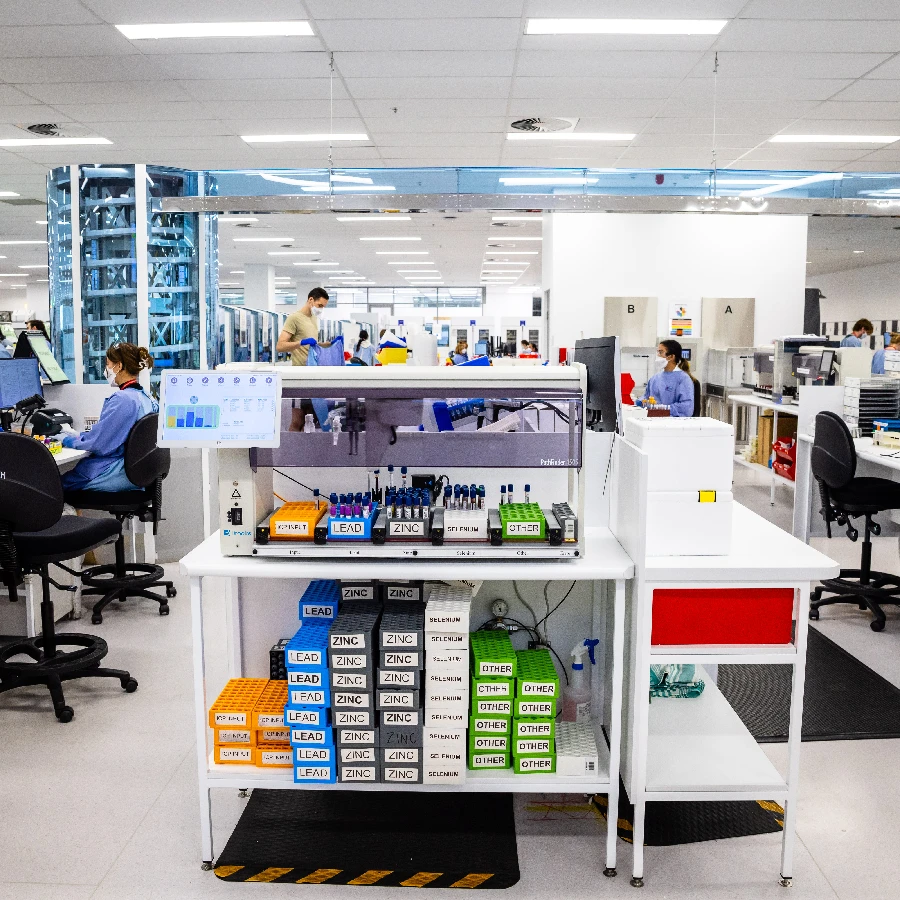

Lab Automation
Delivering an Automated Advantage for Our Customers
Modern lab environments face increasing pressure to handle higher volumes, support diverse workflows, and operate with limited space and staffing. As testing, research, and analytical requirements evolve, automation must adapt without forcing rigid process redesign or operational disruption.
Brooks’ lab automation solutions are designed to support flexible, modular workflows across clinical, life sciences, and analytical operations. By enabling incremental automation and configurable system design, Brooks helps organizations improve consistency, scale throughput, and adapt to changing operational needs.
Lab Automation Built for Modern Laboratory Environments
Laboratory operations are becoming more complex as testing volumes increase, protocols evolve, and staffing constraints persist. These conditions require automation that can be introduced incrementally, adapted to changing workflows, and integrated with existing instruments and processes.
Brooks lab automation solutions are designed to support this flexibility. By enabling modular deployment and collaborative operation, Brooks helps laboratories apply automation where it delivers immediate value while maintaining the ability to scale and adjust as requirements change.
Reliable Sample Management Systems to Accelerate Outcomes
As a global leader in lab automation, Brooks delivers reliable sample management systems that free scientists and lab staff to focus on innovation and discovery—while automation takes care of the rest. By automating repetitive tasks, our scalable solutions reduce manual handling, increase walk‑away time, and ensure predictable, high‑quality outcomes. The result is faster results, higher throughput, and streamlined workflows that maximize operational value and accelerate meaningful outcomes.
PreciseFlexTM Robots
PreciseFlex robots support automated sample handling and instrument loading and unloading in laboratory environments where automation must operate safely alongside people and delicate equipment. These robots are used to automate repetitive tasks while maintaining flexibility as workflows and protocols change.
PreciseFlex robots help laboratories improve consistency and throughput while enabling personnel to focus on higher-value discovery and innovation.

Laboratory Automation Solutions
Brooks Laboratory Automation Solutions support laboratories seeking flexible, scalable automation across pre‑analytical, analytical, and post‑analytical workflows. These systems automate critical sample handling processes while allowing laboratories to configure and expand automation as needs evolve.
Designed for today’s demanding lab environments, Brooks solutions help improve efficiency, consistency, and traceability while reducing manual handling and operational complexity. From compact benchtop systems to high‑throughput platforms and vendor‑neutral software, Brooks enables laboratories to operate more efficiently today and scale with confidence for tomorrow.
Applications Across Laboratory Operations
Brooks lab automation solutions are applied across laboratory environments where consistency, accuracy, and throughput are essential. These applications support organizations seeking to automate targeted processes while maintaining flexibility as workflows evolve. They are common across clinical diagnostics, life sciences research, analytical laboratories, and laboratory-adjacent manufacturing environments.
Sample Handling and Transfer
Automating the movement of samples between laboratory processes to reduce manual handling, improve traceability, and support consistent workflow execution across shifts and protocols.
Instrument Loading and Unloading
Supporting reliable interaction with analytical instruments by automating repetitive loading and unloading tasks, helping laboratories maintain utilization while reducing operator variability.
Tube Sorting, Decapping, and Sealing
Automating routine pre- and post-analytical tasks such as tube sorting, decapping, and sealing to improve consistency, reduce errors, and support higher testing volumes.
Analytical Sample Preparation and Autosampling
Supporting preparation and autosampling workflows where precision and repeatability are critical, helping laboratories manage increasing throughput without compromising analytical integrity.
Workflow Support Across Pre-and Post-Analytical Processes
Enabling automation that supports broader laboratory workflows, helping laboratories coordinate multiple process steps while maintaining adaptability as protocols and testing requirements change.
High-Value Problems Addressed by Lab Automation
Managing Workflow Variability Across Laboratory Operations
Laboratories support a wide range of sample types, protocols, and testing volumes that change over time. Rigid automation systems can limit flexibility and require frequent process redesigns as needs evolve.
Brooks’ lab automation solutions are designed to support adaptable workflows, helping laboratories manage variability while maintaining operational consistency.
Balancing Throughput Demands with Accuracy and Repeatability
As laboratories scale testing and analytical workloads, maintaining accuracy and repeatability becomes increasingly challenging. Manual processes and fragmented automation can introduce variability that impacts data quality and productivity.
Brooks’ automation platforms help laboratories increase throughput while supporting consistent handling and repeatable operation across workflows.
Integrating Automation Without Disrupting Existing Operations
Many laboratories operate in constrained environments with limited space, legacy instruments, and established workflows. Introducing automation without disrupting ongoing operations is a significant challenge.
Brooks’ lab automation solutions are designed for modular integration, allowing laboratories to introduce automation incrementally while preserving existing workflows and infrastructure.
Supporting Long-Term Flexibility as Laboratory Needs Evolve
Laboratory requirements evolve due to new assays, regulatory changes, and shifting research priorities. Automation systems must adapt without requiring complete replacement.
Brooks’ modular automation approach helps laboratories scale and reconfigure automation as operational needs change.
Designed for Real Operational Constraints
Laboratory automation must operate within constraints such as limited bench space, variable sample volumes, evolving protocols, and regulatory requirements. Automation systems that lack flexibility or are difficult to adapt can create inefficiencies rather than improvements.
Brooks designs lab automation solutions with these realities in mind, emphasizing modularity, predictable operation, and compatibility with existing laboratory instruments and workflows. This approach helps laboratories introduce automation that supports operational goals without disrupting day-to-day work.
Learn More About Brooks Lab Automation Solutions
Explore Brooks’ lab automation platforms designed to support flexible laboratory workflows.

